
Haryana Chief Minister Nayab Singh Saini has launched development projects worth 253 crore in Jind district, focusing on irrigation, infrastructure, health, and water supply.

10 stocks from the Nifty 200 index that offer good growth potential and scope to deliver decent returns from current levels, based on brokerage estimates.

'At the first sign of real trouble, that money will move. There will be a run.'

From the Sensex basket, NTPC, Power Grid, IndusInd Bank, Tata Steel, Tata Motors, JSW Steel, Tech Mahindra and Larsen & Toubro were the biggest gainers. Bharti Airtel, Maruti, ICICI Bank and Asian Paints were the laggards.

Quarterly earnings, macroeconomic data announcements and global trends will drive the Indian stock markets in a holiday-shortened week, analysts said. Stock markets would remain closed on Wednesday for the Guru Nanak Gurpurab holiday.

Precious metal prices, particularly gold and silver, experienced a significant surge in the national capital as investors sought safe-haven assets amid escalating hostilities in the Middle East.

With the Budget overhang gone, investors are breathing a sigh of relief and are back to make fresh calls.
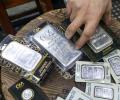
Silver prices extended their record-breaking rally for a sixth straight session on Monday, surging 6 per cent to touch a lifetime high of Rs 2,54,174 per kilogram in futures trade amid strong investor demand and bullish global trends. On the Multi Commodity Exchange (MCX), silver futures for March delivery surged Rs 14,387, or 6 per cent, to hit a new record of Rs 2,54,174 per kilogram.
Benchmark stock indices Sensex and Nifty closed on a flat note in a choppy session on Wednesday as gains in PSU banks and auto shares were offset by losses in IT stocks.

Gold and silver prices are expected to maintain their upward trajectory this week, but may see late profit-booking amid the release of a series of crucial global economic indicators, analysts said. On the economic front, traders will closely monitor the manufacturing/ services PMI data from across regions and the US non-farm payrolls/ employment data along with consumer confidence for the month of September and speeches from several Federal Reserve officials, they added.

Shares of tyre manufacturers have outperformed broader equity benchmarks, buoyed by multiple tailwinds. Softer raw material prices, an uptick in demand from automakers following the reduction of the goods and services tax (GST) rates, and steady replacement demand have lifted sentiment toward the sector.

Just over a year ago, India was investors' top pick among EMs. Its slide down the rankings follows $30 billion (over 2.5 trillion) of foreign selling over the past 12-13 months.

Beijing has been wary of Sanae Takaichi's efforts to boost Japan's military profile since taking office six months ago, points out Dr Rajaram Panda.

Market sentiment is likely to remain cautious as investors position themselves for the upcoming Union Budget and the US Fed's interest rate decision, where expectations are muted.

There is record underperformance and under-ownership. Some of this is cyclical and will turn on its own. However, we also need to regain our growth credentials. For this, both the government and companies have a role to play, as do investors, points out Akash Prakash.
From the Sensex pack, Asian Paints, ICICI Bank, PowerGrid, Larsen & Toubro, Bajaj Finserv, Bharti Airtel, Sun Pharmaceuticals, Maruti Suzuki India, Axis Bank, UltraTech Cement and HCL Technologies were the only gainers. On the other hand, Eternal, Tata Motors' commercial vehicles arm, Mahindra & Mahindra, Tata Steel, Bharat Electronics Ltd, Tata Motors Passenger Vehicles, Trent, Tata Consultancy Services, Hindustan Unilever, and Infosys were among the laggards.

'Trade deal will act as a strong trigger for market sentiment, not just for domestic investors but also for FIIs.'

Trading activity of foreign investors and crude oil prices would also remain in the limelight during the week, experts noted. "This week brings a series of important economic data releases from India and the United States, which are likely to influence market sentiment and central bank outlooks.


Through the past 12 months, the Bank Nifty has risen 55%

India overtakes Australia following the election rally; market cap could cross $1.5 trillion in 12 months, close to that of Switzerland.

'The pace of gold's ascent is striking, with prices rising from $3,500/oz to $4,000/oz in just 36 days -- far quicker than the historical average of 1,036 days taken to achieve similar $500/oz gains.'

There are a few factors that can spoil the party

The clock on the ceasefire is running out. But everyone's already whispering about round two, possibly as soon as this weekend.

Among Sensex firms, HCL Tech, ICICI Bank, Titan, Trent, Kotak Mahindra Bank, Hindustan Unilever, Mahindra & Mahindra and HDFC Bank were the major laggards. However, Adani Ports, Bharti Airtel, SBI, NTPC and Sun Pharma were among the gainers.

It has mostly been a one-way street for markets that have moved up sharply since July. The front-line indices - the S&P BSE Sensex and the Nifty50 - have gained 6.7 per cent and 7.3 per cent, respectively, in the past three months. The rally in mid- and small-caps has been sharper, with both indices surging 14 per cent and 9 per cent, respectively, during this period. This sharp run has made analysts at Jefferies cautious.

From the 30-share Sensex pack, Tata Consultancy Services and Infosys jumped over 4 per cent each. HCL Technologies, Tech Mahindra, Adani Ports, Larsen & Toubro, Maruti and Reliance Industries were also among big gainers. Titan, IndusInd Bank, Hindustan Unilever, Axis Bank and HDFC Bank were the laggards.

From the Sensex firms, Tata Steel tanked the most by 4.57 per cent. ICICI Bank, Power Grid, HCL Tech, Tech Mahindra, Infosys and Kotak Mahindra Bank were also among the laggards. Mahindra & Mahindra, State Bank of India, ITC and Bharat Electronics were among the gainers.

Liquidity issues post the crisis at DHFL, progress of monsoon, rupee trajectory at the domestic level and oil prices are some factors that will keep markets choppy, analysts say.

'Except for extremely conservative investors, others can consider allocating 10 to 20 per cent of their portfolio to small caps.'

'Oil is still well below its all-time highs, and the world is gradually running out of known reserves.'

'...a mix of asset classes.' 'Include equities for growth (across market caps), debt for stability and liquidity, gold as a hedge against macro and currency risk, and global assets for geographical and economic diversification.'

Is the parabolic rise in silver running out of steam or just getting started? Ramalingam Kalirajan offers his take on if you should invest in silver now?

Gold extended its record-breaking run to breach the Rs 1.5 lakh per 10-gram mark in futures trade on Tuesday, while silver surged to a lifetime high of Rs 3.27 lakh per kg as investors rushed to safe-haven assets amid mounting global tensions. On the Multi Commodity Exchange (MCX), gold futures for February delivery climbed Rs 6,861, or 4.7 per cent, to record Rs 1,52,500 per 10 grams after settling at Rs 1,45,639 per 10 grams in the previous session.

Stock markets will be driven by RBI's interest rate decision, tariff-related developments, global trends and trading activity of foreign investors in this holiday-shortened week, analysts said.

Equity markets will keenly track outcome of the US Federal Reserve policy meeting this week amid heightened expectations of an interest rate cut along with WPI inflation data, analysts said. Any further development on the USndia trade front would also drive trends in the equity market, experts said.
With the earnings season drawing to a close, stock markets will take cues from global trends and foreign investors' trading activity this week, analysts said. The US FOMC (Federal Open Market Committee) minutes will be the major highlight this week, experts said. "This week, there are fewer cues on the macro and micro fronts, as the Q1 earnings season has concluded.

Bharat Electronics, Reliance Industries, Mahindra & Mahindra, Larsen & Toubro, InterGlobe Aviation, ICICI Bank and UltraTech Cement were among the other major gainers. Axis Bank, Infosys, Tata Consultancy Services, Trent and Titan were the laggards.

Indian frontline benchmarks - the S&P BSE Sensex and the Nifty50 - have rallied around 12 per cent each since June-end and outperformed their global peers by a wide margin. On Thursday, the US Fed hiked interest rates by another 75 basis points (bps) - the third such hike this year - and surprised the markets by projecting further sizable hikes in the coming months. With the latest hike, the Fed fund rate (FFR) now stands in the range of 3 - 3.25 per cent and is highest since January 2008.

Benchmark indices maintained their winning momentum for the fourth day running on Tuesday, helped by a rally in Asian and European markets and continuous foreign fund inflows. The 30-share BSE Sensex climbed 374.76 points or 0.62 per cent to settle at 61,121.35. During the day, it jumped 543.14 points or 0.89 per cent to 61,289.73.
